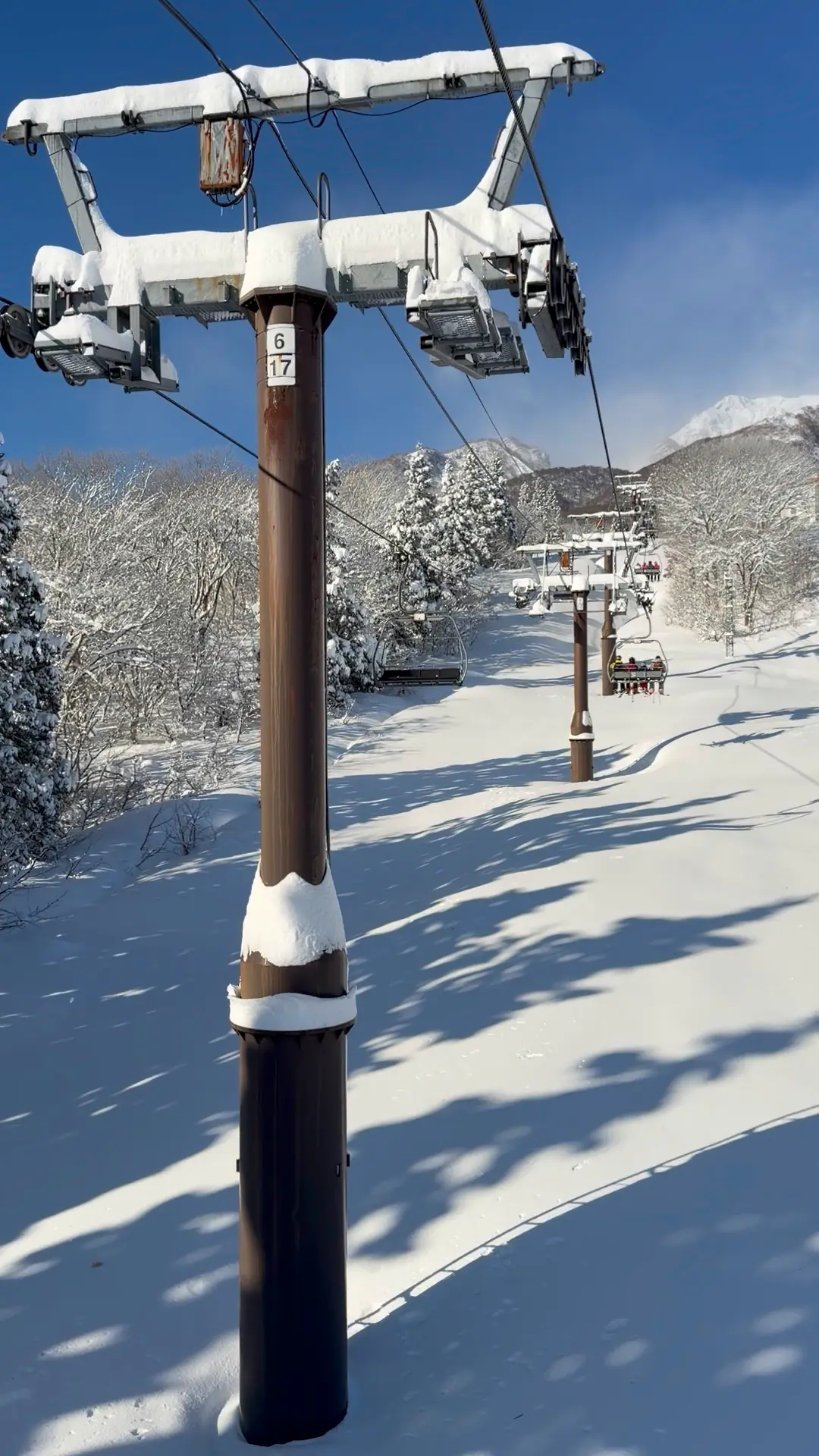
A snow-covered chairlift tower, a groomed run and the mountains at Myoko, Niigata
Ski Guide THFirst-time ski & snowboard guide from Thailand

A guide from Thailand · 2026–27 season

First time skiingin Japan

Close to Thailand, visa-free for Thai passports and world-class snow. That's why Japan is where most Thai travellers ski first. This page covers everything to know before your first day on the slopes.

15 daysVisa-free stay for Thai passports (until 30 Jun 2027). Check the latest rules before you travel.
Jan–FebBest powder | Main season is Dec–Mar
¥6,000–13,500Adult 1-day lift ticket, 2026–27 season, depending on resort and dates

© 2026 First-Time Ski Guide · Myoko · Niigata · Original photos. Please don't reuse without permission.

Trail Rating↓ Slope rules

Getting started

Ski or snowboard?

Both use the same slopes. What differs is your stance and how the first lessons feel. Pick one for your first trip and try the other later.

Skiing

Two skis, facing downhill, legs move independently.

  • Easier to balance on day one because your feet aren't strapped together.
  • Getting on and off lifts is simple. Nothing to take off.
  • The most common injury is the knee (ACL) from twisting in a fall, so the rental shop must set your bindings for your real weight and level.

Snowboarding

One board, standing sideways, both feet strapped in.

  • Expect lots of falls in the first two or three days. Wrists, shoulders and ankles are the usual injuries. Wrist guards and impact shorts help.
  • Once it clicks, turning often comes quickly.
  • You unstrap one foot for every lift ride, and flat sections or surface lifts (T-bars) are hard for beginners.

Still unsure? Choose skiing for your first trip. You'll fall less on day one and start having fun sooner.

↑ Back to top

Before you go

Visa & travel

For Thai travellers, Japan is the easiest ski destination when it comes to paperwork.

Visa: Thai ordinary passport holders

Visa-free for up to 15 days. Have your return ticket and hotel details ready.
  • Applies to: holders of a valid Thai e-passport, including children, on short stays of up to 15 days per visit. The waiver runs until 30 Jun 2027 (renewed year by year, so check again before you go).
  • Visa-free entry covers tourism, visiting family and short business trips or meetings. Paid work is not allowed.
  • You need a visa before travelling if you stay longer than 15 days, or go to work (including part-time resort jobs), study or do an internship.
  • Immigration may ask to see: a return or onward ticket, proof of funds (cash or credit card), your accommodation address and travel plans. Keep them on your phone or printed.
  • Air tickets issued after 30 Jun 2026 already include Japan's ¥3,000 departure tax. Nothing extra to pay at the airport.

Visa: special cases

Past entry bans, other passports, and the coming JESTA system
  • Not eligible for visa-free entry: people previously deported or banned from Japan. If you have ever overstayed or been refused entry, ask the Japanese embassy before booking.
  • Living in Thailand on another passport: the rules for your passport apply. Check the visa-exemption list on Japan's Ministry of Foreign Affairs website. If your country isn't listed, apply for a visa in Thailand.
  • If you need a visa: Japan raised visa fees from 1 Jul 2026. Check the latest baht amount with the embassy or visa centre.
  • Coming later: Japan plans an online pre-travel authorisation (JESTA) for visa-exempt visitors, including Thais, expected around 2028. Not needed for the 2026–27 season.

Ski insurance

Not required, but buy it and make sure it covers skiing
  • Japan doesn't require insurance to enter, but medical and rescue costs abroad are very high. Buy it.
  • Before buying, read the policy's "exclusions". Check whether it excludes only "ski racing" or all skiing and snowboarding.
  • Check the medical limit and the emergency evacuation or repatriation limit, including search and helicopter costs (ideally in the millions of baht).
  • Skiing off-piste or ducking ropes into closed areas is usually not covered. Injuries while drunk often aren't either.
  • Check third-party liability (if you hit someone) and cover for damaged or lost rental gear. If unsure, ask the insurer to confirm in writing.

Getting there

Fly into New Chitose for Hokkaido, or Tokyo for Nagano and Niigata
  • For Hokkaido, fly into New Chitose (Sapporo), then take a ski bus to Niseko, about 3 hours depending on roads and snow.
  • For Nagano or Niigata, fly into Tokyo and continue by shinkansen.
  • You can send big luggage ahead to your hotel with a delivery service (takkyubin). It makes travel much easier.

↑ Back to top

Timing

When to go

Hokkaido opens earlier and closes later than Honshu. Early and late season are cheaper and quieter, but in late Nov–early Dec some resorts have only a few runs open, so check what's actually open before booking. For beginners, mid to late March is often the best balance of snow, price and crowds.

Niseko charges peak prices for the whole of 24 Dec – 28 Feb, not just New Year and Lunar New Year. Resorts near Tokyo are busy every weekend and on Japanese public holidays. Late in the season, snow at lower resorts gets heavy and wet. Resorts open and close on different dates, so check before booking.

↑ Back to top

Where to ski

Good resorts for a first trip

Japan has hundreds of ski areas. These five were picked for being beginner-friendly, easy to reach and ready for international visitors.

GALA Yuzawa

About 90 minutes from Tokyo by shinkansen, with the station opening straight onto the ski base. Easy as a day trip, ideal if you want to try skiing for one day during a Tokyo holiday.

One-day tryNo transfersBusy on holidays

2024–25 prices: adult ¥6,800/day at the counter · ¥5,900 online (check 2026–27 prices on the official site)

Hakuba Valley

A valley of 10 resorts on a single lift pass, with great views of the Japanese Alps and a real ski-town feel. Beginners should start at Tsugaike Kogen, which has wide, gentle slopes. If you only ski Tsugaike, its own ticket is cheaper than the valley pass (the valley pass is sold online and takes credit cards only).

Multi-day tripsEnglish worksPlan your shuttles

All-resort valley pass, adult ¥11,100/day (2026–27)

Niseko United

The lightest, most reliable snow of the group. Restaurants, ski schools and rental shops all work in English. The downside is it's the most expensive.

Best snowEverything in EnglishExpensive

All Mountain adult 1-day pass, 2026–27: ¥13,500 peak (24 Dec–28 Feb) · ¥12,600 regular · ¥8,800 early season (28 Nov–11 Dec) and spring (23 Mar–4 Apr)

Nozawa Onsen

An old hot-spring village with the slopes right behind it. Walk to an onsen after skiing. Under two hours from Tokyo by shinkansen plus a short bus ride.

Good valueOnsenAuthentic Japan

Adult regular-season lift ticket about ¥7,800/day (check 2026–27 prices on the official site)

Myoko Kogen

A cluster of ski areas around Mt Myoko, such as Akakura Onsen, Akakura Kanko and Ikenotaira. Very heavy snowfall and lots of ryokan-style onsen hotels. From Tokyo, about 2 hours by shinkansen to Joetsu-Myoko station, then a bus or taxi. Less English than Niseko or Hakuba, and many restaurants close around 8 pm.

Reasonable pricesOnsenFew local buses

Akakura Onsen adult lift ticket ¥7,000/day · day plus night ¥8,500

↑ Back to top

Budget

On-mountain cost calculator

A rough per-person estimate. Flights, lodging and food are not included.

Days on the snow
3
Rental gear (per day)

Estimate per person

¥0

About 0 Thai baht

Lift tickets¥0
Rental¥0
Lessons¥0
Thai baht (sample rate, change it if needed)

Rental prices are from a shop in Grand Hirafu, Niseko. Honshu resorts are usually much cheaper. Group lessons are set at about ¥20,000/day; in Niseko for 2026–27 a half day is about ¥15,000–22,000 and a full day about ¥17,000–25,000 depending on dates, with peak season the highest. Other resorts may differ. Multi-day passes are usually cheaper than the daily price times the number of days (e.g. Hakuba 5 days ¥53,400). The exchange rate is an estimate; check the real rate before you go.

↑ Back to top

Packing

What to pack

Dress in layers you can take off. Skiing makes you sweat, but sitting on a lift makes you cold. Waterproof outer layers can be rented at the resort; bring your own base layers. Tick items off as you pack.

To wear

Documents and essentials

Packed 0 of 18

↑ Back to top

On the snow

Your first day, step by step

In the order you'll meet them on your first morning.

  1. Sort out rental gear first thing

    Rental shops get busy by mid-morning, so book online if you can. Give your real weight, height, age and ability. The shop uses them to set how easily your bindings release in a fall, which lowers the risk of injury. Try boots on with one pair of thin ski socks, don't tuck your trousers into the boots, and walk around the shop for a while. Boots should be snug with your heel staying down, but not so tight your feet go numb.

  2. Buy a lift ticket

    On day one you may only use the beginner area. Some resorts sell half-day tickets or cheaper tickets for the short beginner lifts. Ask at the counter before buying a full-mountain ticket.

  3. Take a lesson

    The best money you'll spend on the trip. Take lessons for at least the first one or two days (or half days over two or three days) to learn safe, correct basics. It beats a friend teaching you, which usually ends in a day of falling. Group lessons are cheaper. Private lessons cost more but you improve faster, which suits nervous learners or people with physical limits. Young children have separate kids' ski schools (minimum ages vary). Big resorts have English-speaking instructors.

  4. Start on the beginner slope and the conveyor

    Beginner areas usually have a moving carpet instead of a chairlift. Practise walking with one ski on, then glide down a gentle slope until you can stop by yourself.

  5. Stopping and slowing down

    Skiing: the pizza (snowplough). Point your ski tips together and push the tails out into a wedge. The harder you press the edges into the snow, the slower you go. Snowboarding: stand across the slope and press your heel edge, sliding left and right (the falling leaf). Practise until you can stop every time before riding a lift.

  6. Learn to fall and get up

    When you fall, lean to the side or sit down. Don't put a straight arm out. Snowboarders should land on their bottom or forearms rather than their wrists. To get up, turn your skis or board across the slope and push up from the uphill side.

  7. Your first chairlift

    Take your backpack off or wear it on your front. Skiers hold both poles in one hand. Snowboarders keep only the front foot strapped in. Look back, wait for the chair to touch the back of your legs, then sit. Lower the safety bar (some lifts in Japan don't have one) and only raise it at the unload sign, then stand and glide off to the side. On your first ride you can ask the operator to slow the lift. If you miss the unload point, stay seated and wait for the lift to stop. Don't jump.

↑ Back to top

Safety

Rules on the slopes

Japanese slopes show difficulty with colours on signs and maps. Beginners should stick to green.

GreenEasy, gentle. Start here.
RedIntermediate, once you can turn well.
BlackDifficult, very steep. Not yet.

↑ Back to top

Language

Japanese words you'll see often

Makes reading signs and talking to staff easier.

JapaneseSay itMeaning
rifuto-kenLift ticket
rentaruRental shop
shoshinshaBeginner. Seen on beginner slopes and lesson signs.
sukī-jōSki area
gerendeSki slope
kassō kinshiNo skiing, closed area
patorōruSki patrol. Call them if someone is hurt.
kōsu-gaiOff course, keep out
onsenHot spring
rokkāLocker

↑ Back to top